WALTHERS 932-2587 Kansas Beef Packers Witchita Meat Reefer Scale Line Ho
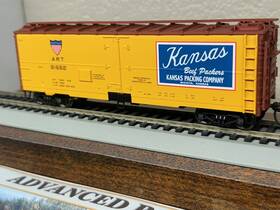
( Brand: Walthers ), ( Manufacturer Part Number: 932-2587 ), ( Assembly Status: Ready To Go/pre-built ), ( Color: Multicolor ), ( Replica Of: Meat / Ice Reefer ), ( Material: Plastic ), ( Grade: C-9 Factory New-brand New ), ( Year Manufactured: 2012 ), ( Age Level: 17 Years Up ), ( Control System: Dc/dcc ), ( Franchise: Gold Line Series ), ( Gauge: Ho ), ( Vintage: Yes ), ( Type: Freight Car ), ( Rail System: Two-rail System ), ( Corporate Roadname: Kansas Beef Packers ), ( Theme: Railroading ), ( Features: Limited Edition, Painted, Metal Wheels, Knuckle Couplers ), ( Country/region Of Manufacture: China )
Review WALTHERS Kansas Beef Packers Witchita Meat Ice Reefer Ho Scale Gold Line New
Walthers 932-2587 HO Scale Kansas Beef Packers Wichita Meat Reefer
The Walthers 932-2587 HO Scale model represents the Kansas Beef Packers meat reefer train car, specifically designed to transport perishable goods such as meat from the packing plants to various destinations. This intricately detailed model is a must-have for any HO scale model railroad layout that features a livestock or food industry theme.
The exterior of the model boasts authentic Kansas Beef Packers livery, with intricate logos, lettering, and detailing accurately reproduced from the prototype. The car body is crafted from high-quality plastic, allowing for a realistic appearance and durability. The roof features a detailed refrigeration unit with piping and vents, while the doors have functional sliding mechanisms that allow easy access to the interior.
The undercarriage of the model is equally impressive, with authentic couplers, brake wheels, and detailed suspension and springing. The car also includes separately applied handrails, ladders, and other exterior details for added realism. The wheels themselves are also finely detailed, with realistic tread patterns and metal flanges.
The interior of the model is equally well-appointed, with a detailed refrigeration unit and flooring that accurately represents the interior of a real meat reefer car. The car interior is also designed to accommodate various types of meat or other perishable cargo, allowing modelers to customize their layouts to suit their specific interests.
Overall, the Walthers 932-2587 HO Scale Kansas Beef Packers Wichita Meat Reefer is a high-quality, intricately detailed model that is perfect for any HO scale model railroad layout featuring a livestock or food industry theme. With its accurate detailing, authentic livery, and functional features, this model is sure to impress even the most discerning model railroad enthusiast.
Walthers 932-2587 Kansas Beef Packers Wichita Meat Reefer Pros, Cons, and Concluding Recommendation
Introduction:The Walthers 932-2587 Kansas Beef Packers Wichita Meat Reefer is a HO scale model designed to add realism to your model railway layout. This model represents a meat reefer car, which is a type of refrigerated freight car used to transport perishable goods, such as meat, from production sites to distribution centers. Let's discuss the pros and cons of investing in this HO scale model.
Pros:1. High Detail: The Walthers 932-2587 model boasts impressive detail, including realistic paint schemes, accurate lettering, intricately designed doors, and functioning couplers.
2. Functional: This model features a working door and a detailed interior, making it an excellent addition for modelers who enjoy the challenge of operating and maintaining their models.
3. Durable: The model is constructed from high-quality materials, ensuring it can withstand the rigors of transportation and handling.
4. Authentic: The Walthers 932-2587 model closely resembles real-life meat reefers, making it an ideal choice for modelers who prioritize authenticity in their layouts.
5. Adds Realism: By adding a meat reefer to your layout, you can significantly enhance the realism of your scene, as these types of cars are common sights on real-life railroads.
Cons:1. Price: The Walthers 932-2587 model is not an inexpensive purchase. Modelers on a tight budget may prefer less-detailed or older models to save costs.
2. Size: As a HO scale model, the Walthers 932-2587 meat reefer is relatively small compared to the actual size of a freight car. This may not be suitable for larger layouts or modelers who prefer larger scales.
3. Complexity: The functional features of this model, such as the working door, may be challenging for beginners to operate and maintain.
4. Limited Functionality: While the model offers functional doors, it does not have lighting or other advanced features found in more expensive models.
Conclusion:The Walthers 932-2587 Kansas Beef Packers Wichita Meat Reefer is an excellent choice for modelers who prioritize detail, realism, and durability in their HO scale models. Its functional features, authentic design, and high-quality construction make it a worthwhile investment for both experienced modelers and those looking to enhance their skills. However, its price and size may be limiting factors for some modelers, and its complexity may not be suitable for beginners.
Recommendation:If you are an experienced modeler with a budget for high-quality, detailed HO scale models, the Walthers 932-2587 Kansas Beef Packers Wichita Meat Reefer is an excellent addition to your layout. Its impressive detail, functional features, and authentic design make it a worthwhile investment for enhancing the realism of your scene. However, if you're a beginner or looking for a less expensive model, you may want to consider a less-detailed or older model to save costs. Alternatively, you could explore N or O scale models, which offer larger models at lower price points.
Details:
Cushioned trucks and draft gear to minimize jarring bruising of produce. The refrigerator car radically altered the meat business. The sliding plug door was introduced experimentally by P.F.E. Refrigerator cars differ from simple insulated boxcars and ventilated commonly used for transporting fruit, neither of which are fitted with cooling apparatus.
Provisions for pre-cooling the cars with a portable unit at loading platforms. The item is NEW in the original box from old stock. He started his career in the shipping of fruits. China, Greece, and Rome stored ice snow in caves, dugouts or houses lined with straw other insulating materials.
Depending on the cargo and destination, cars may have been fumigated. Meat processors sought a method to ship dressed meats from their Chicago packing plants eastern markets. Rationing of the ice allowed preservation foods during hot periods, a practice that was successfully employed for centuries. A number of attempts were made during the mid-19th century to ship agricultural products via rail car.
These tight-fitting doors were better insulated and could maintain an even temperature inside the car. Built to move meat from packinghouses big cities, these all-steel reefers were some of the most colorful cars on rails. Standardized interior dimensions to allow improved loading methods with standardized containers. Fruit and fresh produce.
Hammond, a Detroit meat packer, who built set of cars to transport his products Boston using ice from the Great Lakes for cooling. Unlike produce reefers, they were fitted with hooks and overhead rails that matched those used in slaughterhouses processing plants to speed loading unloading. He sold the design in 1868 to George Hammond, a Chicago meat packer, who built set of cars transport his products Boston. It was ultimately determined that top-icing is useful only in preventing an increase temperature and eventually discontinued.
They are hard to part with but due downsizing in retirement they tare looking for a good home which can appreciate and enjoy them. Out - Of Production. At high altitudes or northern latitudes, one-foot tanks were often filled with water and allowed to freeze. Ice blocks also called cakes are manually placed into reefers from a covered icing dock.
The practice, dating back almost to the inception of refrigerator car, saved ice and resulted in fresher cargo. Upon reaching their destination, the cars were unloaded. Chases design proved to be a practical solution, providing temperature-controlled carriage of dressed meats. Background: North America.
Hair felt derived from compressed cattle hair, sandwiched into the floor and walls of car, was inexpensive, yet flawed over its three to four-year service life it would decay, rotting out cars wood en partitions tainting cargo with a foul odor. Placing meat directly against ice resulted in discoloration and affected the taste, proving to be impractical. Steel cars vs wood for better insulation protection and greater rigidity resulting in reduced leakage around doors. Many of these unique items are from my personal inventory which was accumulated over the years.
The meat was packed tightly at the bottom of car to keep gravity low and prevent cargo from shifting. His father was Joseph Earl, his mother Adela Chaffed, and brother Guy Chaffed Earl. Adjustable ice bunker bulkheads to allow greater floor space for shippers using top icing alone. In addition to operating and servicing refrigerated railcards, FGE became a major manufacturer of insulated boxcars mechanical cars.
The death of animals weakened by the long drive further increased per-unit shipping cost. Perforated floor racks providing similar protection and air circulation under the cargo. Refrigerator cars required effective insulation to protect their contents from temperature extremes. Operated by both railroads and private owners, they were in service from the late 1940s to 1970s.
Milk cars and other types of express reefers may or not include a cooling system, but are equipped with high-speed trucks and modifications that allow them to travel passenger trains. Forced air circulation within the car. Crushed ice was typically used for meat cars. The train would depart for the eastern markets.
Early attempts at refrigerated transport. Driving cattle across the plains also caused tremendous weight loss, with some animals dying in transit. Synthetic materials such as fiberglass and polystyrene foam, both introduced after World War II, offered the most cost-effective practical solution. THIS IS AN ASSEMBLED Item.
This type of door provided a larger six foot opening to facilitate car loading and unloading. The cars were cleaned with hot water or steam. Vertically adjustable grates within the ice bunkers to allow half-stage icing reduce charges where appropriate. The cars' ice bunkers were filled, either manually from an icing dock, via mechanical loading equipment, or in locations where demand for was sporadic using specially designed field cars.
Lettered for. This icebox on wheels was a limited success since it only functional in cold weather. The cars were delivered to the shipper for loading, and ice was topped-off. The load had the tendency of swinging to one side when car entered a curve at high speed, and use units was discontinued after several derailments.
It had been postulated that as the ice melts, resulting chilled water would trickle down through load to continue cooling process. The use of ice to refrigerate and preserve food dates back prehistoric times. Competing firms such as Armour and Company quickly followed suit. Ready-To-Run.
The cars were riced in transit approximately once a day. Top icing added considerable dead weight to the load. Gold Line TM.
In 1857, the first consignment of dressed beef was carried in ordinary boxcars retrofitted with bins filled ice. Reefers can be ice-cooled, come equipped with any one of a variety mechanical refrigeration systems, or use carbon dioxide as dry ice liquid nitrogen as cooling agent. He was the first to achieve this. The higher cost of other materials such as Lino felt woven from flax fibers or cork prevented their widespread adoption.
GOLD LINE Series. DISCONTINUED By The Manufacturer. Detroit's William Davis patented a refrigerator car that employed metal racks to suspend the carcasses above frozen mixture of ice and salt. Soon after, mechanical refrigeration units replaced the armies of personnel required to re-ice cars.
It was found, however, that top-icing only benefited the uppermost layers of cargo, and water from melting ice often passed through spaces between cartons pallet's with little or no cooling effect. Most of these items are New in the box removed only to take photos them. Through the ages, seasonal harvesting of snow and ice was a regular practice many cultures.
part #: 9322587 prices
- $15.00-$43.95
specifications mthoscaletraingi:
- brand: Walthers
- mpn: 932-2587
- assembly status: Ready To Go/pre-built
- color: Multicolor
- replica of: Meat / Ice Reefer
- material: Plastic
- grade: C-9 Factory New-brand New
- year manufactured: 2012
- age level: 17 Years Up
- control system: Dc/dcc
- franchise: Gold Line Series
- gauge: Ho
- vintage: Yes
- type: Freight Car
- rail system: Two-rail System
- corporate roadname: Kansas Beef Packers
- theme: Railroading
- features: Limited Edition, Painted, Metal Wheels, Knuckle Couplers
- country/region of manufacture: China
shipping mthoscaletraingi:
- class: Standard, Expedited
- transit: 3-8 Days
- cost: $9.10
- service: USPS Ground Advantage, USPS Priority Mail
- carrier: USPS
- type: Calculated
offer mthoscaletraingi:
- availability: In Stock
- options: Ship-to-home
- started: March 3, 2025
- sold: 0
- quantity: 2
general mthoscaletraingi:
- model Railroads Trains > Railroads Trains > Freight Cars
- condition: New
seller mthoscaletraingi:
- # reviews: 15562
- city: Van, Texas
- rating: 100.0%
payments mthoscaletraingi:
- other
- credit card: Visa
- wallet: Google-pay
returns mthoscaletraingi:
- time: 30 Days
- policy: Returns Accepted
- paid by: Seller
- method: Money back
Walthers 932-2587 Is Similar To:
- 932-2576 Walthers Raskin Packing Sioux City Ia Meat Reefer Urtx (44.7% similar) Gary shipping do combine shipping when possible. If you know anyone in northeast or mid-Atlantic that might be looking to sell a collection, please let me. Smart post, which is a combination of FedEx and the USPS, usually least expensive for large items or you are located far away. Letter a on one ...(September 23rd, 2018)
- 920-17312 Walthers Ho Scale Proto General American Rea Steel 616374107247 (29.6% similar) The Walthers 920-17312 is in new condition...(December 26th, 2021)
- 932-3722 Walthers Nib Ho Gold Line Icg Airslide Covered Hopper (33.1% similar) The Walthers 932-3722 is in new condition...(December 29th, 2021)
- 931-1863 Walthers Ho Scale Norfolk Southern Ry Thrall Mill Gondola Car (28.9% similar) Original box. No missing or broken parts. The Walthers 931-1863 is in new condition...(December 31st, 2021)
- 910-7691 Walthersmainline Walthers Ho Scale Nsc Covered Hopper Canadian 616374173822 (35.8% similar) Modernize ho grain operations in minutes with the 60 NSC 5150 cubic foot 3-BAY covered hopper from Walthers mainline. Fully assembled and ready for service, features include 100-TON roller bearing trucks. The Walthers mainline 910-7691 is in new condition...(December 31st, 2021)
- 932-34107 Walthers Ho Scale Center Beam Flat Car Hampton 616374000364 (25.3% similar) Item is probably discontinued. Cars equipped with horn hook couplers. The Walthers 932-34107 is in new condition...(January 4th, 2022)
- 910-5471 Walthersmainline Walthers Ho Scale General American Flatcar Southern 616374149032 (34.6% similar) The prototypes handled 40FOOT, 45FOOT and 48FOOT trailers and 20FOOT and 40FOOT containers from 1961 to the 1980 S. The Walthers mainline 910-5471 is in new condition...(January 17th, 2022)
- Wal931-1754 Walthers Ho Scale Pd Track Cleaning Boxcar Rr 616374091935 (28.9% similar) Use with any ho scale train set. Fully assembled, ready to run. Body-mounted magnetic knuckle couplers. The Walthers WAL931-1754 is in new condition...(January 21st, 2022)
- 932-4305 Walthers Ttx Ho Scale Stand Alone Husky Stack 616374013678 (32.1% similar) TRX #456129 Walthers ho scale stand alone husky stack nib. Walthers part #932-4305. The Walthers 932-4305 is in new condition...(February 5th, 2022)
- 932-7412 Walthers Gold Line Southern Pacific Greenville Ton Twin Hopper (26.3% similar) Up for your consideration is a new Walthers 100 ton southern pacific Greenville twin hopper #465411. The Walthers 932-7412 is in new condition...(February 12th, 2022)
- 9325636 Walthers Ho Scale Depressed Center Flat Car Trucks Ge New (33.8% similar) Ho scale Walthers 75FOOT depressed flat car, 4 trucks, ge, #2002 new vintage. Thanks, bob. The Walthers 9325636 is in new condition...(February 21st, 2022)