WALTHERS 932-41809 Canadian Pacific Level Thrall Enclosed Ho Scale 89FT Auto Carrier Platinum
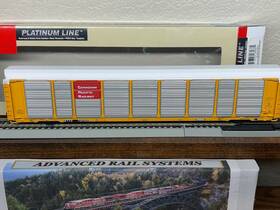
( Brand: Walthers ), ( Manufacturer Part Number: 932-41809 ), ( Assembly Status: Ready To Go/pre-built ), ( Color: Multicolor ), ( Replica Of: Enclosed Auto Carrier ), ( Material: Plastic ), ( Grade: C-10 Mint-brand New ), ( Year Manufactured: 2012 ), ( Age Level: 17 Years Up ), ( Control System: Dc/dcc ), ( Franchise: Platinum Line Series ), ( Gauge: Ho ), ( Vintage: Yes ), ( Type: Freight Car ), ( Rail System: Two-rail System ), ( Corporate Roadname: Canadian Pacific ), ( Theme: Railroading ), ( Features: Limited Edition, Painted, Metal Wheels, Knuckle Couplers ), ( Country/region Of Manufacture: China )
Review WALTHERS Canadian Pacific 89ft Tri level Thrall Enclosed Auto Carrier Ho Scale Platinum
The Walthers 932-41809 Canadian Pacific 89ft Tri-Level Thrall Enclosed Auto Carrier is a meticulously crafted HO Scale model train accessory, part of the Walthers Platinum Series. This auto carrier is an intricate replica of the real-life counterpart used by Canadian Pacific Railway (CP) for transporting vehicles.
The model boasts an authentic tri-level design, enabling it to carry a considerable number of automobiles in a compact space. The enclosed design provides an added layer of protection against the elements, ensuring the safety of the cargo during transit. The exterior of the model is detailed with realistic textures and weathering effects, replicating the worn look of a well-used freight car. The doors can be opened to reveal the interior, where the decking and cross-bracing are accurately represented.
The undercarriage is equally impressive, with accurately modeled Coupler Cut Lever (CCL) and draft gear detail. The wheels are equipped with RP-25 metal wheels, allowing for smooth operation on HO Scale track. The trucks are authentic and feature realistic suspension detail.
The Canadian Pacific logo and reporting marks are prominently displayed on the sides and ends of the auto carrier, adding to its authenticity. This model is a must-have for HO Scale model railroaders looking to add realistic freight cars to their Canadian Pacific Railway layout. The attention to detail and high-quality construction make this an excellent addition to any collection.
Pros and Cons of Buying Walthers 932-41809 Canadian Pacific 89ft Tri-Level Thrall Enclosed Auto Carrier (HO Scale Platinum)
1. Pros:a. High-Quality Detailing: This model boasts intricate and highly-detailed features, including realistic auto carrier doors, couplers, and body paint.
b. Authentic Design: The Canadian Pacific 89ft Tri-Level Thrall Enclosed Auto Carrier accurately represents the prototype in HO scale.
c. Interchangeable Automobiles: The ability to interchange automobile models adds to the realism and flexibility of this model.
d. Magnetically-Coupled: The magnetic couplers make connecting and separating trains easy and smooth.
e. Die-Cast Construction: Die-cast metal parts contribute to the durability and weight of the model.
2. Cons:a. Price: The HO Scale Platinum series models are more expensive compared to standard HO models due to their high level of detail and quality.
b. Limited Clearance: Due to the enclosed design, this model may have limited clearance for other rolling stock or structures on the layout.
3. Conclusion:The Walthers 932-41809 Canadian Pacific 89ft Tri-Level Thrall Enclosed Auto Carrier (HO Scale Platinum) offers a high level of detail, authentic design, and realistic functionality that can significantly enhance the look and realism of any HO scale model railway. However, the higher price point may be a deterrent for some potential buyers. Considering the pros and cons, if the investment in a high-quality, detailed model is a priority, this model is an excellent choice.
4. Recommendation:If you are an HO scale model railway enthusiast looking for a high-quality, detailed auto carrier model for your layout, the Walthers 932-41809 Canadian Pacific 89ft Tri-Level Thrall Enclosed Auto Carrier (HO Scale Platinum) is an excellent choice. If the price is a concern, consider evaluating the importance of having a high-detailed model versus a standard model for your specific layout design and budget.
Details:
Satisfied that the basic concept was sound, railroad contracted with Pullman-Standard to design and construct a full-size tri-level prototype. Over half of all new autos make their first long trip by train, riding in enclosed tri-level auto rack cars. However, thieves and vagrants could still gain access to the automobiles.
CANADIAN PACIFIC CP Logo and Lettering. Most of these items are New in the box removed only to take photos them. Neither design went into commercial production. As some of the longest and tallest equipment in operation, tunnels, bridges or other obstructions can present routing problems that require detours.
Two to four automobiles would usually fit into one boxcar. Pacific Car Foundry briefly produced a few racks at about the same time, as did Thrall. To avoid this, a modified tri-level design was introduced in the mid 1970s. PLATINUM Line TM.
In service with most major roads, they can be found in the staging areas of every auto assembly plant, as well reloading import cars for their return trip. The car side was made up of overlapping perforated steel sheets. Magnetically operated, body mounted couplers. Some modifications included longer boxcars, larger sliding double side doors located near one end of the boxcar, or on boxcar ends.
The circus solution to loading vehicles was use a string of flatcars. Porters Alpaca design, developed in cooperation with Chrysler, was placed into service by ATSF, C NW,RGW, GTW, N W, RF P, SLSF, SP, UP and several other roads, most riding on leased Trailer Train flats. Low-friction, nonmagnetic, needlepoint metal axles. These modifications helped, but the demand for new automobiles outpaced railroads' abilities to build and modify boxcars in which ship them.
PLATINUM LINE Series. Yet, the railroads could still do better. This type of vehicle loading became known as circus due to its frequent use by circuses. Many of these unique items are from my personal inventory which was accumulated over the years.
Railroads known to have done so include ATSF, CN, CP, CR, CRR,RGW, FEC, GN, GTW, KCS, L N, Moon, MP, N W, RI, SCL, SLSF, SOO, Southern, SP, SSW, UP, WM, and WP. The car rode on four single-axle trucks and was tested by the B but no sales resulted. A major problem left to solve was that the new auto rack cars did not provide any protection from theft, vandalism, or severe weather. The Whitehead Kale's tri-level design, renamed Safe-Park, was delivered to ATSF, CP, CRR, FEC, NW, SCL, SSW, UP, and WP, all of them riding on railroad-owned flats.
Eight to ten autos could be carried per flat car in this manner. Auto racks are used to transport new vehicles from factories automotive distributors, and passengers' in car shuttles monorail services, such as Amtrak's Auto Train route. An auto rack, also known as an auto carrier also car transporter outside the US, is a specialized piece of railroad rolling stock used to transport automobiles and light trucks. All they needed now was a ramp at the right height .
Fully assembled and ready for service, these HO Scale model's come in a variety of colorful, modern schemes are complete with working knuckle couplers. Machined-Metal Wheels. These CN cars were similar to conventional boxcars, except they had a second floor and doors at both ends of the car instead usual side. And paint scheme.
A temporary ramp was placed at the end of flatcars and bridge plates spanned gaps between adjacent flatcars; road vehicles were driven or towed up onto one car then down train. Since autos are smaller and shorter than trucks or vans, the third deck increases carrying capacity; usually 15 mid-size 18 compact cars make up a full load. By this time, in the USA, most circuses still traveled by rail. RALISTIC Satin paint finish.
The ends were protected with two trifled doors, and a corrugated steel roof extended the full length of car. Currently auto racks are produced by Trinity Rail, Green brier, Johnstown America, National Steel Car, and the Union Pacific Railroad. No lubrication required.
The success of these assemblies was limited due to their special use and specific size; it proved uneconomical maintain a fleet that could only be loaded into boxcars from the ends cars. Auto racks were built in three-level configurations carrying automobiles, and with two-levels for vans light trucks. Starting in this early period, most auto racks were mounted on flat cars leased from a leasing company, such as Trailer Train see below, North American Car NIFX marks, Merchants Dispatch MDAX Refrigerator Transit MPFX or Pullmans Transport Leasing Division TLCX but many roads also operated their own. They are hard to part with but due downsizing in retirement they tare looking for a good home which can appreciate and enjoy them.
Ready-To-Run. THIS IS AN ASSEMBLED Item. Grab Irons Ladders. Standard Draft gear box.
Detailed engineering plastic truck side frames. They're perfect for model ing bridge traffic moving across your layout. Accurately Scaled from engineering Drawings. Several other railroads quickly ordered their own auto racks from Dana and W K or American Car Foundry, Darby Corporation, Evans Products, Paragon Bridge Steel, Thrall Manufacturing.
The assemblies, also called racks, created two levels on which automobiles could be loaded. Out - Of Production. Such flatcars eliminated the need for specialized equipment to load and unload boxcar racks. Volkswagen engineers worked with German railroads to design a railroad car that was basically an extra long version of vehicle hauling trailer.
But, loading even up to six automobiles onto one flat car left a large amount of space above the vehicles that was unused. Several firms simply exited the field, including AC F, Evans, Dana, and Darby, while others were acquired by other builders. These detailed Gold Line cars also include metal wheel sets and knuckle couplers. Transporting new automobiles.
The item is NEW in the original box from old stock. Lettered for. Great for weathering with chalk or airbrush. The natural solution was to take the temporary assemblies that were used stack and load vehicles within boxcars permanently attach them flatcars.
To complete the flatcar, foldaway bridges were added to ends of flatcar decks allow vehicles be driven entire length a train for loading. Crisp, Detailed, realistic lettering. 89' Tri-level Enclosed Auto Carrier-Assembled. The 89' flat car that carries the rack is a special low-level car, easily identified by side-sill cut outs provide left and right side clearance for trucks.
Lettering Matched to prototype photographs. They carried more vehicles in the same space and were easier to load unload than boxcars formerly used. DISCONTINUED By The Manufacturer. It featured mesh screen side panels, vertically sliding three-piece doors, and a similar roof.
part #: 93241809 price
- $87.95
specifications mthoscaletraingi:
- brand: Walthers
- mpn: 932-41809
- assembly status: Ready To Go/pre-built
- color: Multicolor
- replica of: Enclosed Auto Carrier
- material: Plastic
- grade: C-10 Mint-brand New
- year manufactured: 2012
- age level: 17 Years Up
- control system: Dc/dcc
- franchise: Platinum Line Series
- gauge: Ho
- vintage: Yes
- type: Freight Car
- rail system: Two-rail System
- corporate roadname: Canadian Pacific
- theme: Railroading
- features: Limited Edition, Painted, Metal Wheels, Knuckle Couplers
- country/region of manufacture: China
general mthoscaletraingi:
- condition: New
- model Railroads Trains > Railroads Trains > Freight Cars
payments mthoscaletraingi:
- other
- credit card: Discover
- wallet: Paypal
offer mthoscaletraingi:
- started: September 12, 2025
- sold: 0
- quantity: 2
- options: Ship-to-home
- availability: In Stock
returns mthoscaletraingi:
- paid by: Seller
- policy: Returns Accepted
- time: 30 Days
- method: Money back
seller mthoscaletraingi:
- # reviews: 15806
- city: Van, Texas
- rating: 100.0%
shipping mthoscaletraingi:
- service: USPS Ground Advantage, USPS Priority Mail
- cost: $13.20
- class: Standard, Expedited
- carrier: USPS
- type: Calculated
- transit: 5-11 Days
Walthers 932-41809 Is Similar To:
- 920-17312 Walthers Ho Scale Proto General American Rea Steel 616374107247 (25.9% similar) The Walthers 920-17312 is in new condition...(December 26th, 2021)
- 931-1863 Walthers Ho Scale Norfolk Southern Ry Thrall Mill Gondola Car (24% similar) Original box. No missing or broken parts. The Walthers 931-1863 is in new condition...(December 31st, 2021)
- 910-7691 Walthersmainline Walthers Ho Scale Nsc Covered Hopper Canadian 616374173822 (34.3% similar) Modernize ho grain operations in minutes with the 60 NSC 5150 cubic foot 3-BAY covered hopper from Walthers mainline. Fully assembled and ready for service, features include 100-TON roller bearing trucks. The Walthers mainline 910-7691 is in new condition...(December 31st, 2021)
- 932-5303 Walthers Union Pacific Bethgons Coal Cars No Loads In Box (42.9% similar) Walthers union pacific bethinks coal cars no loads 6-PACK - new in box. The Walthers 932-5303 is in new condition...(January 3rd, 2022)
- 932-34107 Walthers Ho Scale Center Beam Flat Car Hampton 616374000364 (26.5% similar) Item is probably discontinued. Cars equipped with horn hook couplers. The Walthers 932-34107 is in new condition...(January 4th, 2022)
- 920-101932 Walthers Ho Potlatch Thrall Boxcar 616374166435 (32.3% similar) This is a Walthers 920-101932 ho scale pot latch 56FOOT thrall all-door boxcar #124 2-TONE green. Features of this layout-ready replica include: limited edition - one time run of these road numbers! prototypes hauled lumber from LATE-1960S to early 2000 S, etched end platforms with cross-over irons...(January 14th, 2022)
- 910-5471 Walthersmainline Walthers Ho Scale General American Flatcar Southern 616374149032 (35.3% similar) The prototypes handled 40FOOT, 45FOOT and 48FOOT trailers and 20FOOT and 40FOOT containers from 1961 to the 1980 S. The Walthers mainline 910-5471 is in new condition...(January 17th, 2022)
- Wal931-1754 Walthers Ho Scale Pd Track Cleaning Boxcar Rr 616374091935 (26.3% similar) Use with any ho scale train set. Fully assembled, ready to run. Body-mounted magnetic knuckle couplers. The Walthers WAL931-1754 is in new condition...(January 21st, 2022)
- 932-4305 Walthers Ttx Ho Scale Stand Alone Husky Stack 616374013678 (29.3% similar) TRX #456129 Walthers ho scale stand alone husky stack nib. Walthers part #932-4305. The Walthers 932-4305 is in new condition...(February 5th, 2022)
- 910-8001 Walthers Mainline Ho Open Auto Rack Santa Fe Atsf (36.1% similar) Expand auto traffic on your 1960 S and early 70S ho layout with a fleet of Walthers mainline 89FOOT flatcars with bi-level open auto racks. Designed for light trucks and similar larger vehicles, the prototypes entered service in 1968 and featured open sides. The Walthers mainline 910-8001 is in ...(February 7th, 2022)
- 920-110024 Walthers Ho Canadian National Russell Snowplow 616374167913 (28.7% similar) This is a Walthers 920-110024 ho scale canadian national Russell snowplow #55245 red, noodle logo. Take on winters worst with a Walthers Porto Russell snowplow on the job! in service since the 1920S, all-steel plows like this are a must have for railroads big and small, and look great spotted on a ...(February 10th, 2022)